
What is GauOpen?
GauOpen is an open source software package designed to facilitate complex computational tasks, especially ones requiring cooperation between multiple software program/components. GauOpen is intended to be a general purpose tool, allowing cooperation between Gaussian 26 and other applications, in a software- and programming language- agnostic a manner as possible. GauOpen consists of a binary data file used to share results and an open source library providing access to the data file and capable of running Gaussian calculations.
Binary Array File (BAF)
Preserve full numerical precision using a compact binary format.
✓ No truncation
✓ Efficient storage
✓ Seamless data exchange
✓Self-defining format
Automation
Define any type of workflow involving Gaussian calculations
Repeatable as desired under any conditions
Use control structures for sophisticated decision-making
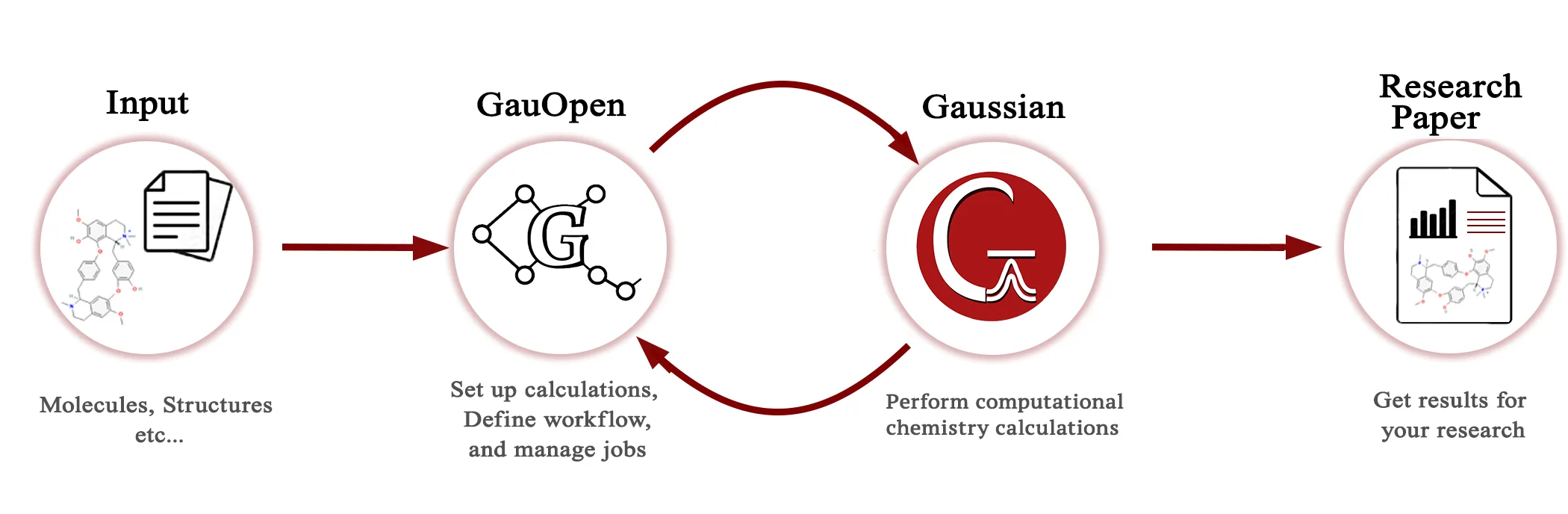
Integration
Exchange results with other computational chemistry applications; Gaussian can control the calculation, and Gaussian can be an engine for another application. Existing interfaces include Tinker md NBO.
Tinker
Molecular dynamics with a polarizable force field. Tinker controls the MD calculation of the energy and forces and uses them to drive the trajectory. Tinker computes the bonded and Van der Waals terms and calls Gaussian to compute the QM, electrostatic and polarization terms. Communication is handled by GauOpen routines, and data exchange is made via the BAF.
NBO
Natural Bond Orbital analysis uses data from Gaussian, either final results necessary for simple analysis or more complex interactions for more advanced capabilities. For example, Natural Energy Decomposition Analysis (NEDA) begins with Gaussian providing the partitioning of the molecular system to NBO, which is used for a standard NBO analysis. Next, a deletion analysis is performed to isolate the charge transfer contribution to the interaction energy. Finally, Gaussian uses the NBO-provided localized fragment densities to evaluate each fragment energy. This information, along with the one- and two-electron integrals, is returned to NBO in order to compute the various terms in the total energy.
Experimentation and Prototyping
Create new models using results from Gaussian in conjunction with new code that allows experimentation with minimal programming
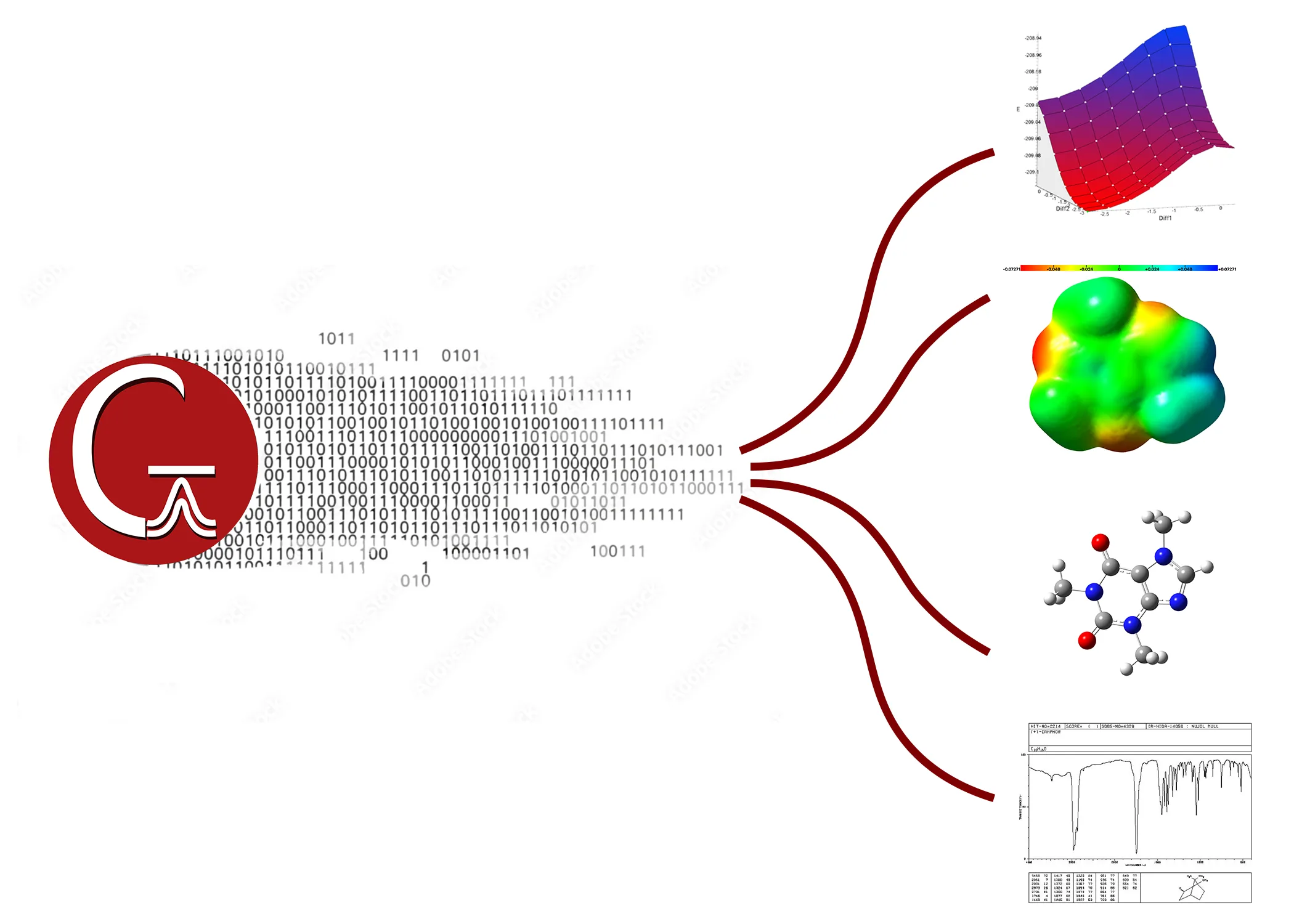
Post-Processing
Extract additional insights from Gaussian calculations through automated analysis and transformation of simulation data.
✓ Advanced visualization
✓ Statistical analysis of MD trajectories
✓ Reaction rate calculations
✓ Charges for molecular mechanics
Binary Array File
(BAF)
No loss of precision due to truncation from conversion to text
Teaching
Learn computational chemistry by building small components instead of complete applications. Students can program selected models or processes while Gaussian performs the full computation.